
Hoi An stole our hearts during our two-week Vietnam family trip, and after spending a week here with our extended family over Chistmas—including kids ranging from our 2-year-old to teenagers—I can confidently say it’s one of the best family destinations in Southeast Asia.
Our first stop of Da Nang was our place to explore with the whole group (19 people!) and celebrate Dani’s parents anniversary. After 7 nights, we transferred to Hoi An to slow down the page with a smaller group of 10 and keep the celebrations going for Christmas. After a whirlwind week of immersing oursleves in Vietnamese food (and plenty of massages), we transferred 45 minutes south to spend our second week in Hoi An.
Hoi An is charming—ancient streets lit by hundreds of colorful lanterns at night, a riverside Old Town, family-run restaurants serving recipes passed down for generations, and a laid-back energy that somehow accommodates both cultural immersion and pure relaxation. It’s small enough to navigate easily with kids but packed with enough activities to fill a week (or more) without anyone getting bored.
We spent seven days in Hoi An with our multi-generational crew of 10 people, including kids ranging from our 2-year-old Arlo to teenagers. This is everything we did, what worked brilliantly, what we’d change, and all the practical details you need to plan your own Hoi An family adventure.
[If you like this post, we also took a big multi-generational trip to Iceland and break down our itinterary day-by-day!]
Why Hoi An is Perfect for Families
Before I dive into specific activities, here’s why Hoi An worked so well for us:
Walkable and safe. The Old Town is compact and pedestrian-only in the evenings, making it easy to explore with kids without constantly worrying about traffic. Even our toddler could toddle around without us being on high alert.
Genuinely kid-friendly culture. Vietnamese people love children, but in Hoi An especially, we felt welcomed everywhere we went with kids in tow. Restaurant staff smiled and played with the kids, even held Arlo. One server even started feeding him lol! The vibe was warmly accommodating rather than merely tolerant.
Perfect activity variety. Hoi An balances cultural experiences (cooking classes, ancient architecture, traditional crafts) with adventure (bike tours, basket boats, beach time) and fun (tailoring, lantern-making, endless cafés). There’s something for every age and interest.
Easy pacing. Unlike cities where you feel pressure to see all the sights, Hoi An rewards slow exploration. You can wander the same streets multiple times and discover something new. This low-pressure atmosphere is ideal when traveling with kids who have unpredictable energy levels.
Incredible food scene. Some of Vietnam’s best food is in Hoi An, and it’s approachable for kids. The local specialties (cao lau noodles, white rose dumplings, bánh mì) are mild enough for pickier eaters while still being interesting for adventurous adults.
Affordable indulgence. Like Da Nang, Hoi An is incredibly affordable, but it also offers unique experiences (custom tailoring, cooking classes, private boat tours) that feel special without breaking the budget.
The 12 Best Things to Do in Hoi An with Kids
1. Bike Tour Through the Countryside (Don’t Miss This)
Best for: Kids ages 2+ (with child seats/tag-alongs for younger ones)
Cost: $35-40 per person including lunch, bikes, and all activities
Time commitment: Half day (4-5 hours)
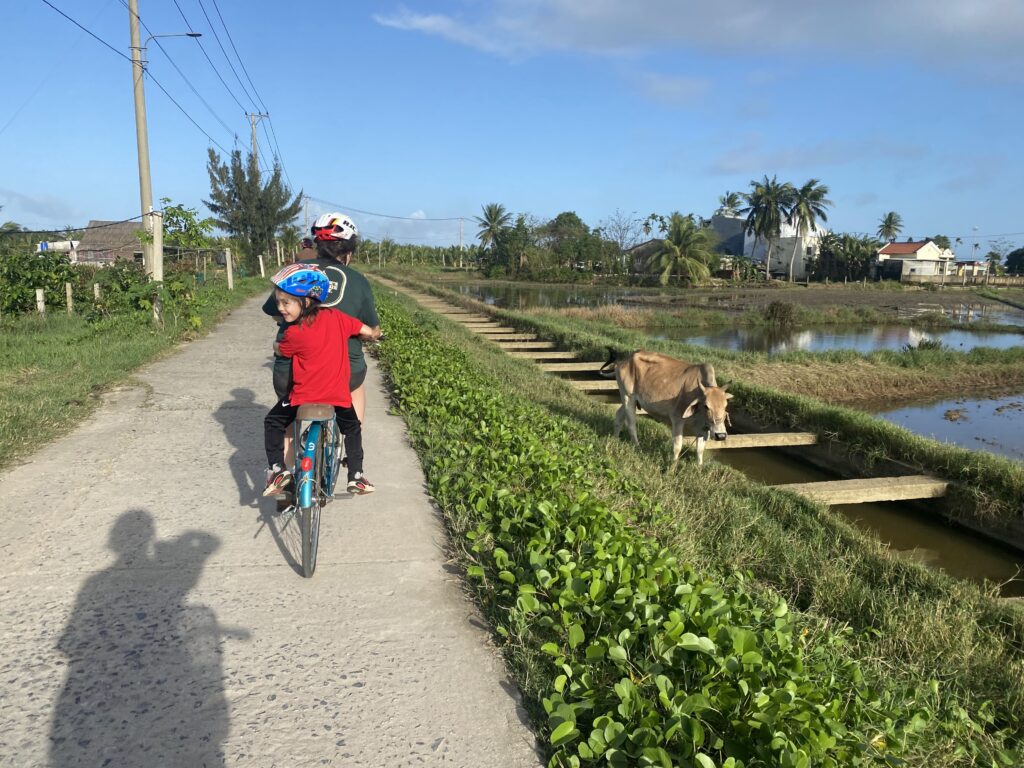
If I had to pick one single activity that made our entire Vietnam trip, it would be this bike tour through Hoi An’s countryside with Heaven & Earth Bicycle Tours. It exceeded every expectation and created memories we’re still talking about months later.
Our guides picked us up after lunch and fitted everyone with bikes—including a child seat for our 2-year-old Arlo and bench seats for the 6-year-olds who were too young to safely ride solo through some tricky sections near traffic. We set off through rice paddies, vegetable gardens, and villages on mostly quiet paths that felt unchanged for generations.
First stop: Organic farm. We learned about Vietnamese farming practices, saw vegetables we’d been eating but didn’t know how they grew, and the kids got to help harvest greens. There was also a puppy, which immediately became the highlight for our youngest crew members.
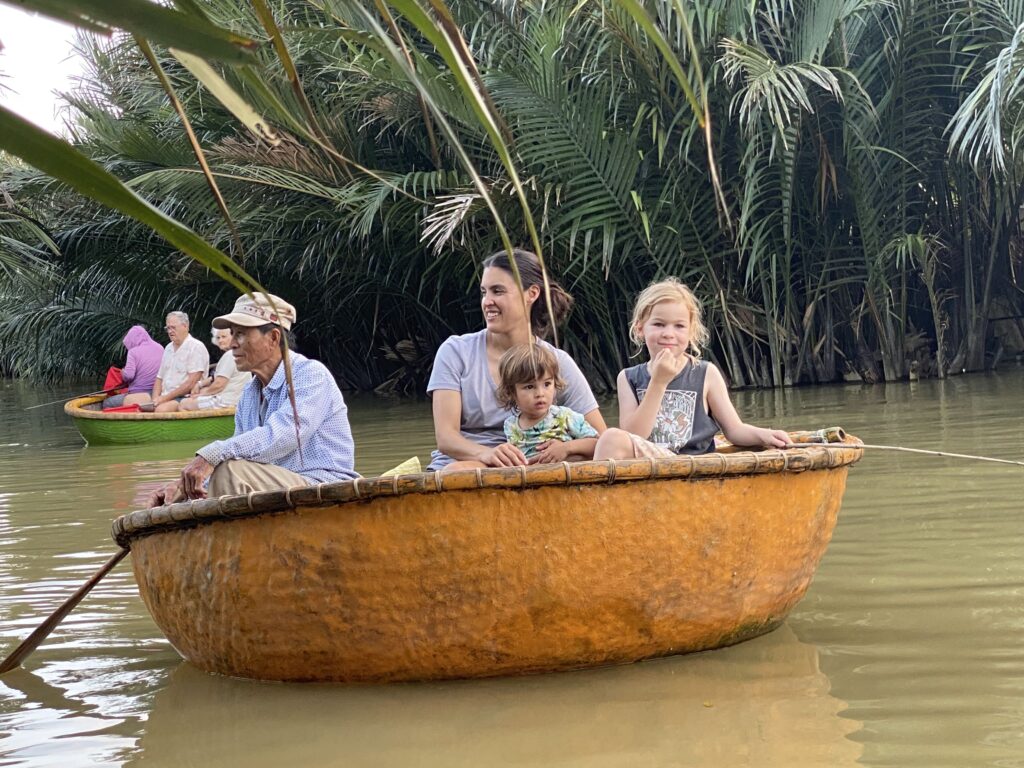
Basket boats in the coconut palm forest. These round traditional fishing vessels are significantly harder to paddle than they look. Our guides spun us in circles until we were dizzy and laughing. Even the teenagers who’d been “too cool” for some activities were fully engaged and competitive about who could master the boats.
Full transparency: The basket boat section was packed with other tourists, which was the only downside. But our guides kept the energy fun, and we managed to have a great time despite the crowds.
Dinner stop: Riverside family restaurant. We made fresh spring rolls, ate the crispy bánh xèo pancakes we’d learned about in Da Nang (wrapped in rice paper with herbs and peanut sauce), and heard about recent flooding in Hoi An and how grateful locals were that visitors were returning.
Surprise ending: Night boat ride. After dinner, instead of biking back, our guides had us leave the bikes and took us via boat back through Old Town’s canals as the sky darkened. We floated past lantern-lit streets and watched others releasing floating canterns on the water—a relaxing, magical way to end an active day.
What made it perfect:
- The guides customized everything for our mixed-age group
- Multiple types of activities (biking, farming, boats, cooking) kept everyone engaged
- It felt genuinely authentic rather than touristy (despite the basket boat crowds)
- Physical activity was balanced with cultural learning
- Kids felt like adventurers, not just tourists following adults around
Practical tips:
- Book at least a few days in advance—Heaven & Earth can customize for large groups
- Morning tours are available but afternoon/evening tours end with the magical night boat ride
- They provide helmets for all ages
- The biking isn’t strenuous—mostly flat terrain, easy pace
- Child seats and tag-along bikes available for young kids
- Bring mosquito repellent for the coconut forest section
Honest take: This was our most expensive activity per person, and it was worth every penny. If you only do one organized tour in Hoi An, make it this one.
2. Old Town Exploration & Lantern Magic
Best for: All ages, especially magical in the evening
Cost: Old Town entrance ticket $6-8 per person (valid for multiple entries), but lots of areas are free to wander
Time commitment: 2-4 hours per visit (we went multiple times)
Hoi An’s Old Town is the heart of the city—narrow streets lined with centuries-old buildings, shops selling silk lanterns and tailored clothing, restaurants spilling out onto sidewalks, and at night, hundreds of colorful lanterns transforming everything into something from a fairy tale.
The Old Town is pedestrian-only from 6pm onwards, which makes it perfect for families. You can stop and look at things without constantly managing safety. The energy is festive but not chaotic.
What we did:
- Wandered with no agenda, letting kids lead us down interesting alleys
- Stopped at riverside cafés for Vietnamese coffee and fresh juice
- Released floating lanterns on the river (the kids loved this ritual)
- Browsed shops without pressure to buy (though we did end up with way too many silk scarves)
- Ate dinner at different riverside restaurants on different nights
- Watched street performers and musicians
The ticket system: An Old Town ticket gives you access to certain historic houses, assembly halls, and museums. Honestly? We bought tickets but barely used them. The magic of Hoi An is in wandering and soaking up the atmosphere, not checking off official sights. With young kids especially, structured museum visits felt like a hard sell when there was so much to see just walking around.
What worked:
- Going multiple times at different hours (afternoon light vs. nighttime lanterns were completely different experiences)
- Not over-planning—our best discoveries were cafés and restaurants we stumbled upon
- Letting kids pick which streets to explore
- Building in time to just sit and watch rather than constantly moving
Evening magic: Hoi An at night is genuinely special. The lantern-lit streets, the reflection on the river, the warm glow spilling from restaurants—it creates an atmosphere that even our 2-year-old seemed to find enchanting. We’d walk through Old Town after dinner, sometimes buying fresh fruit from vendors, sometimes stopping for dessert, sometimes just wandering.
Practical tips:
- Old Town gets crowded 6-8pm—go earlier or later for fewer people
- Many restaurants have rooftop terraces with great views but check for railings if you have climbers
- Street vendors will approach you constantly—a polite “no thank you” works fine
- Watch for bikes and scooters on side streets even during pedestrian hours
- Public bathrooms are limited—use restaurant bathrooms when you can
Food recommendations in Old Town:
- Cao lau at pretty much any local place (it’s hard to find bad cao lau in Hoi An)
- Morning glory (garlic sautéed greens) everywhere
- White rose dumplings at specialized spots
- Fresh fruit and smoothies from street vendors
Skip if: Your kids melt down in crowds. Old Town in the evening is busy and stimulating—if that’s overwhelming rather than exciting for your crew, go during daytime or skip it entirely.
3. An Bang Beach: The Better Beach Experience
Best for: Beach-loving families who want a laid-back vibe
Cost: Beach clubs charge for loungers ($5-10), or sometimes there’s just a food/drink minimum
Time commitment: Half day to full day
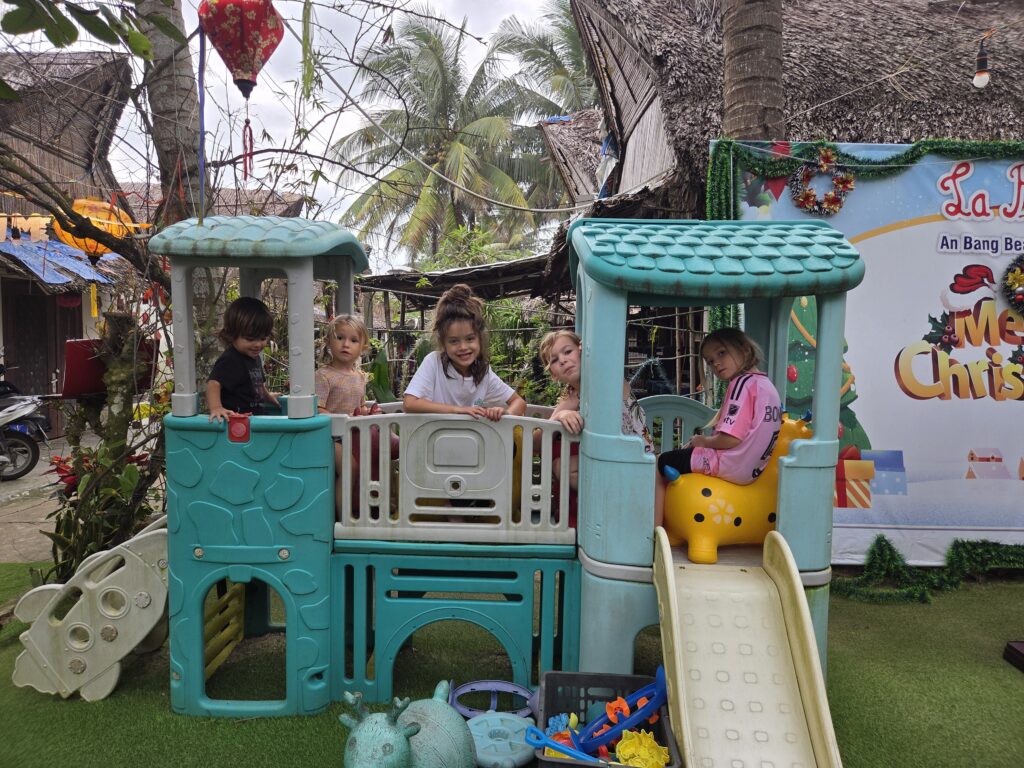
An Bang Beach is about 15 minutes from central Hoi An, and it’s a completely different vibe from Da Nang’s more developed beaches. It’s quieter, more local, less polished—in the best way.
We spent a full day here meeting up with friends who’d moved to Vietnam a few months earlier. Having their local perspective and seeing Hoi An through expat eyes gave us a different appreciation for the city.
What made it work:
- The beach clubs (we went to Dolphin Kitchen & Bar) had everything we needed: comfortable loungers, good food, clean bathrooms, a small playground area, even a pool table where kids played while adults lingered over lunch
- The water was calm enough for younger kids to play safely (although it was drizzling and the kids were happy on the sand)
- The vibe was mellow—a few wandering vendors but not aggressive, no pressure, just relaxed beach time
- Our expat friends brought their kids (same ages as ours), and watching the local/foreign kid interactions was sweet
What we loved about Dolphin Kitchen & Bar:
- Excellent food that went beyond typical beach club fare
- Playground kept kids entertained between swimming sessions
- Staff was incredibly friendly with kids
- Cold beer for adults, fresh juice for kids
Other An Bang beach clubs worth considering:
- Soul Kitchen (more upscale, great cocktails)
- Salt Pub (popular with backpackers and families)
- The Deck (good food, nice ambiance)
Practical tips:
- Go midweek for fewer crowds (weekends get busier with domestic tourists)
- Bring reef-safe sunscreen—Vietnamese sun is strong
- Beach clubs provide shade, but bring hats anyway
- Water is generally calm but always supervise young kids
- Scooter is the easiest way to get there if you’re comfortable riding, otherwise Grab works fine
Real talk: An Bang isn’t the world’s most spectacular beach. The sand is nice, the water is pleasant, but you’re not coming here for jaw-dropping scenery. You’re coming for the relaxed atmosphere, the beach clubs, and the escape from Old Town’s tourist energy. For families, that combination is perfect.
4. Family Cooking Class (The Perfect Final Activity)
Best for: Kids ages 5+ who can participate in actual cooking
Cost: $30-35 per person including market tour, cooking, and lunch
Time commitment: Half day (4-5 hours with market tour)
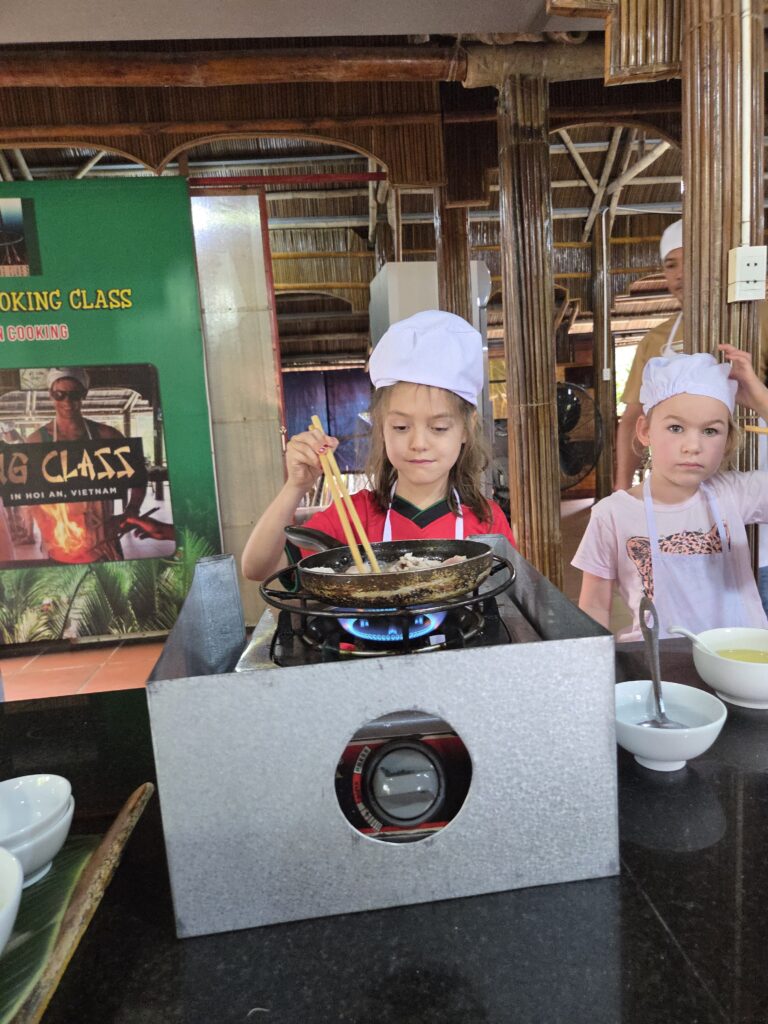
We saved this for our final full day in Vietnam, and it was the perfect culminating activity. We booked with Green Bamboo Cooking School, and it delivered everything we wanted—hands-on cultural experience, delicious food, and something the whole family could do together.
The experience:
Market tour first. Our instructor took us through a local market, explaining ingredients, letting us taste things, showing us how to select good produce. The kids were fascinated by live seafood, exotic vegetables, and fruits they’d never seen. This educational component made the cooking more meaningful—they weren’t just following recipes, they understood where ingredients came from.
Individual cooking stations. Back at the cooking school, each person (or family unit) had their own station. We learned to make fresh spring rolls, fish sauce from scratch, bánh xèo (those crispy pancakes), grilled eggplant with special sauce, pho, and papaya salad. The instructors were incredibly patient with kids, guiding small hands through wrapping spring rolls and flipping pancakes without taking over completely.
What made it special: Cooking together—grandparents, parents, kids all working side by side, laughing at mistakes (Dani burned her first pancake, Remi over-stuffed her spring rolls), celebrating successes (Arlo successfully wrapped a spring roll with help, our 6-year-old perfectly grilled eggplant). These collaborative moments created bonds that outlast any temple visit.
The meal. We ate everything we made for lunch, and it was genuinely delicious. There’s something extra satisfying about eating food you’ve prepared yourself, especially for kids who tend to be pickier eaters.
Recipe cards to bring home. The school gave us laminated recipe cards for everything we made. We’ve actually used them since returning—Vietnamese cooking is more approachable than you might think, and recreating dishes at home extends the trip memories.
What worked:
- The pacing—active cooking interspersed with tasting and instruction
- Age-appropriate tasks for different skill levels
- The pride kids felt making real food, not “kid versions”
- Eating together at big communal tables after cooking
- Taking home tangible skills and recipes
Practical tips:
- Book in advance—these classes fill up, especially Green Bamboo
- Morning classes are most common (starting 8-9am)
- Wear closed-toe shoes (cooking schools require this)
- Bring an appetite—you’ll make and eat a LOT of food
- Kids should be old enough to follow instructions and use basic cooking tools safely
- Some schools offer shorter classes without market tours if time is limited
- Tra Que Cooking Class (in the vegetable village, slightly more rustic)
- Morning Glory (run by famous local chef, more upscale)
- Countryside Cooking Class (combines biking with cooking)
Skip if: Your kids are too young to participate meaningfully (under 5) or have extreme food pickiness that will make them miserable trying new things.
Honest take: This was expensive relative to most Hoi An activities, but it checked multiple boxes—cultural education, hands-on activity, family bonding, delicious meal, and useful skills. For us, absolutely worth it.
5. Custom Tailoring (A Uniquely Hoi An Experience)
Best for: Adults and older kids who want custom clothing
Cost: Wildly variable—dresses $20-150, suits $100-300, kids’ clothes $20-60
Time commitment: 24-48 hours from measurement to pickup (multiple visits required)
Hoi An is famous for custom tailoring—you pick fabric and style, get measured, and within 24-48 hours have perfectly fitted clothing at a fraction of Western prices. Even if you’re not usually into shopping, it’s such a quintessential Hoi An experience that it felt worth trying.
Our experience:
Dani got measured for several outfits, choosing fabrics and tweaking designs from photos she showed the tailor. The process was fun—looking through fabric options, discussing details, imagining the finished product.
The real joy was getting a tiny red suit made for Remi. The tailor thought it was adorable and put extra care into making it special. Remi got to pick every element—fabric color, button style, lining. The turnaround was less than 48 hours, the craftsmanship was exceptional, and it was a special thing they got to do together.
What to know:
Quality varies WILDLY. Some shops are excellent, some are mediocre, some are bad. Do research. Ask your villa host. Read recent reviews. Look at samples in the shop before committing.
You get what you pay for (mostly). Rock-bottom prices usually mean lower-quality fabric and construction. Mid-range shops often offer the best value—good quality without luxury pricing.
Multiple fittings are important. Good shops will have you come back for at least one fitting before final completion. This is crucial for getting the fit right.
Bring photos. Having clear images of what you want helps tailors understand, especially if you don’t speak Vietnamese.
Timing matters. You need at least 2-3 days in Hoi An to do this properly—day 1 for initial measurement, day 2 for fitting, day 3 for pickup. Rush jobs are possible but less reliable.
Reputable shops we heard good things about:
- Tuong Tailor (where we went, good for kids’ clothes)
- Bebe Tailor (highly recommended by multiple people)
- Kimmy Tailor (popular with expats)
- Yaly Couture (more upscale)
What to order:
- Dresses and tops are easier to fit than pants (no inseam issues)
- Linen and silk work well in the climate and are widely available
- Kids’ clothes are adorable and affordable
- Leather jackets are popular (quality varies)
- If you’re getting a suit, allow extra time for fittings
Practical tips:
- Negotiate prices (it’s expected)
- Pay with cash for better deals
- Get multiple items from one shop for bulk discounts
- Don’t order everything on your first day—see quality first
- Keep in mind you need to pack/carry these items home
Skip if: You’re only in Hoi An for a day or two (not enough time), you hate shopping, or you’re uncertain about sizes and fit (getting alterations back home defeats the purpose).
Real talk: This is touristy. Every shop tries to pull you in. It can feel overwhelming. But if you go to a good shop with clear ideas of what you want, it’s a genuinely cool experience—especially for kids who’ve never had anything custom-made before.
6. Coffee Culture & Café Hopping
Best for: Coffee-loving adults, teens who appreciate aesthetics, anyone who enjoys slower-paced exploration
Cost: Coffee $1-3 per drink
Time commitment: Flexible—30 minutes to several hours
Hoi An has an exceptional café culture that deserves its own category. We’re not just talking about places to grab quick caffeine—these are destinations with stunning design, innovative drinks, and atmospheres ranging from traditional Vietnamese coffee houses to sleek modern spaces to French-inspired patisseries.
Our favorites:
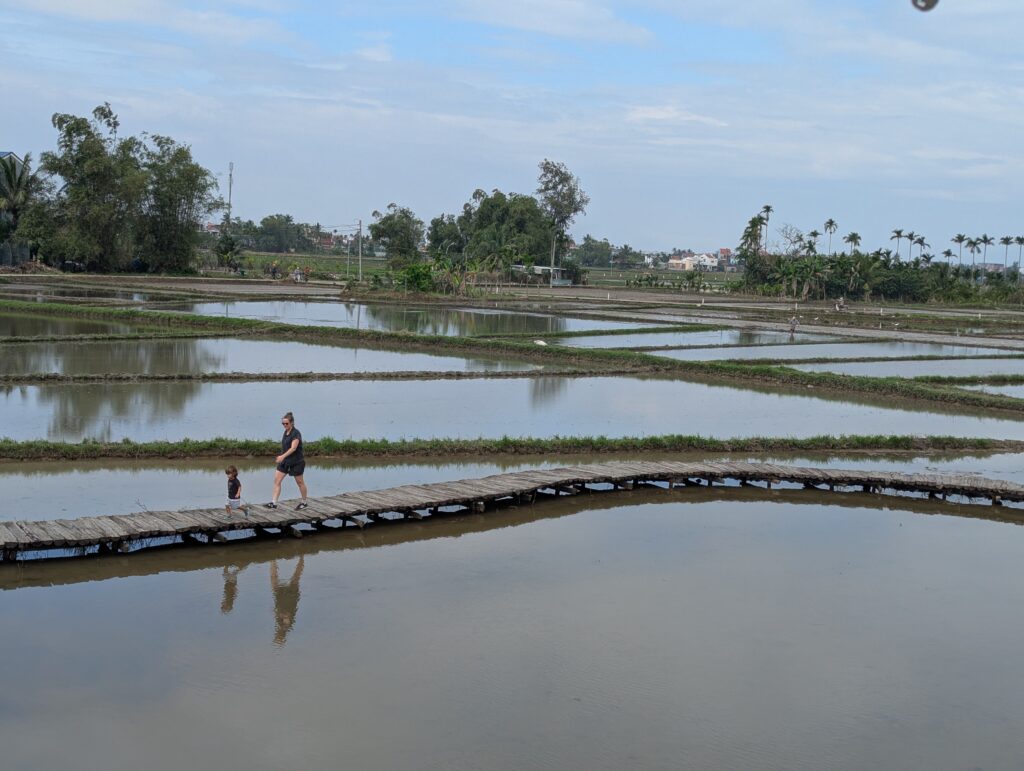
Roving Chillhouse: This sprawling café near our villa became our regular spot. Lounge chairs overlooking rice paddies, multiple seating areas (indoors, outdoors, elevated decks), excellent coffee, and they offer workshops on Vietnamese coffee culture. We went back multiple times for breakfast, coffee, and just hanging out.
Chillax Eatery & Hangout: Just down the road, this multi-level space facing the rice paddies was as chill as advertised. They have frequent events and live music.
The Espresso Station: Modern, sleek, excellent coffee that would hold up in any major Western city. When we craved familiar café vibes, this delivered.
Faifo Coffee: Traditional Vietnamese coffee house with strong coffee, good people-watching, and prices that make ordering multiple drinks guilt-free.
What we did:
- We’d sometimes split up—adults to cafés, kids to playgrounds or markets with other adults
- Morning coffee runs became ritual before activities
- Afternoon breaks when kids needed downtime but adults wanted to be out
The coffee itself:
Vietnamese coffee is STRONG. It’s traditionally made with a phin filter (metal drip) and served with condensed milk, creating an intensely sweet, strong drink. Variations include:
- Salted coffee (our favorite—salted cream on top)
- Coconut coffee (coffee with coconut milk)
- Egg coffee (coffee with whipped egg yolk—sounds weird, tastes amazing)
- Iced black coffee (cà phê đen đá—no sweetener)
Practical tips:
- Cafés are air-conditioned refuges from midday heat
- Most have wifi if you need to get work done or kids need screens
- Don’t feel pressured to order quickly or leave—Vietnamese café culture is about lingering
- Many cafés serve light food (bánh mì, spring rolls, pastries)
- Prices are so low you can try multiple drinks without budget guilt
Why this matters for family travel:
Cafés gave us flexible, low-pressure options when we needed them. If kids were napping at the villa, adults could slip out for coffee. If someone was having a rough morning, a café stop could reset the mood. If we had an hour to kill before dinner, cafés filled the gap perfectly.
It’s not technically an “activity,” but Hoi An’s café culture significantly enhanced our trip by providing beautiful, affordable spaces to exist without agenda.
7. Coconut Forest Basket Boats (If Not Doing the Full Bike Tour)
Best for: Kids who love water and silly fun
Cost: $10-15 per person
Time commitment: 30-45 minutes
We experienced basket boats as part of our bike tour (see #1), but if you’re not doing that full tour, you can do basket boats as a standalone activity. It’s worth doing even if it’s your only water activity in Hoi An.
These traditional round fishing boats are hilariously hard to control. Guides spin you in circles, splash you with water, teach you techniques that may or may not actually work, and generally create joyful chaos on the water. Kids think it’s the best thing ever.
What to know:
- Most tours pick you up from your hotel/villa
- You’ll boat through the coconut palm forest—it’s beautiful and shaded
- Expect to get wet (some guides are enthusiastic about splashing)
- Very touristy—you’ll be with lots of other groups
- Photo opportunities abound (guides are skilled photographers)
Book through: Any tour company in Hoi An offers this. Your villa host can arrange, or book through Klook/GetYourGuide.
Practical tips:
- Bring waterproof phone case for photos
- Wear quick-dry clothes and sandals
- Sunscreen (reflected sun off water is strong)
- Go morning or late afternoon to avoid midday heat
Honest take: It’s touristy and you’ll share the experience with many others. But kids genuinely love it, it’s unique to the region, and it creates great photo/video memories. Worth the minor tourist-trap vibe.
8. Scooter Adventures (For Experienced Riders Only)
Best for: Adults/teens who are licensed and experienced with scooters
Cost: Rental $5-8/day for automatic scooters
Time commitment: Flexible—use for transportation or longer rides
Here’s where I need to be clear: scooter riding in Vietnam is not for beginners. Traffic is chaotic by Western standards, rules are suggestions, and one mistake can have serious consequences. Dani and I are both licensed and have significant experience riding scooters in Asia, so we felt comfortable renting one in Hoi An for local transportation.
What we used it for:
- Runs to cafés and restaurants
- Getting to An Bang Beach
- Exploring areas outside Old Town
- Short trips that were awkward for Grab (too short) but too far to walk with young kids
The experience: All four of us (Dani, me, Remi, and Arlo) piled onto one scooter, which is extremely common in Vietnam. The kids loved it—feeling the wind, seeing everything from a different perspective, feeling like locals. We cruised rice paddies, wound through villages, and navigated Old Town’s less-trafficked streets.
Critical safety points:
- Only do this if you’re genuinely experienced
- Helmets for everyone (required by law, enforced inconsistently)
- Start with short, easy rides to get comfortable
- Avoid main roads during rush hour
- Be extra cautious with kids as passengers
- Check your travel insurance covers scooter incidents (many don’t)
- Rent from reputable shops, check brakes and tires before accepting
Alternative: If you want the experience without the risk, hire a driver with a car or use Grab consistently. You’ll miss some of the freedom and local feeling, but you’ll be safer.
Skip if: You’re not an experienced rider, you’re uncomfortable with traffic chaos, your insurance doesn’t cover scooters, or you have any doubt about your ability to keep kids safe as passengers.
9. Chillax Eatery & Scenic Breakfast Spots
Best for: Families who appreciate good food and beautiful settings
Cost: $3-8 per person for breakfast
Time commitment: 1-2 hours
I’m calling this out separately because finding great breakfast spots transformed our mornings from logistics (how do we feed everyone?) to actual experiences (this is beautiful and delicious).
Chillax Eatery near our villa became our go-to for special breakfast mornings. Stunning views from upstairs tables and decks overlooking rice fields, excellent food (Western breakfast, Vietnamese options, fresh smoothies), and a layout where kids could wander the multi-level decks while adults lingered over coffee.
Why it mattered: Starting the day in a beautiful space with good food set a positive tone. Kids were more willing to try new foods at breakfast when the setting felt special. Adults got actual coffee and conversation before launching into activities.
Other good breakfast spots we tried:
- Roving Chillhouse (mentioned earlier—excellent)
- Various Old Town cafés with river views
- Our villa kitchen (self-catered was often easiest with younger kids)
Practical tip: Breakfast spots are less crowded than dinner restaurants. You can often walk in without reservations and get great seats.
10. Local Markets & Street Food Exploration
Best for: Adventurous families who don’t mind chaos
Cost: Minimal (street food is incredibly cheap)
Time commitment: 1-3 hours
Hoi An’s local markets aren’t technically “attractions,” but exploring them became some of our favorite experiences. Unlike the night markets in Old Town (touristy, geared toward visitors), the day markets are where locals actually shop for food and household goods.
What we did:
- Wandered through produce sections, seeing vegetables we’d been eating but didn’t recognize
- Watched vendors prepare street food—bánh mì assembled with precision, pho broth simmering, grilled meats on tiny charcoal grills
- Let Remi practice ordering in Vietnamese (she’d been taking lessons before the trip)
- Bought fresh fruit for snacks back at the villa
- Ate lunch at plastic tables and chairs on the street, often the only foreigners around
Our favorite discovery: A bánh mì stall that was always busy with locals, the woman running it had the biggest smile every time we showed up (which was often). Best bánh mì of the entire trip, cost less than $2.
What made it special:
- It felt authentic in a way many tourist activities don’t
- Kids saw real Vietnamese daily life, not performances for visitors
- The sensory overload (smells, sounds, colors, activity) was exciting rather than overwhelming
- Remi’s pride in using her Vietnamese skills to order and interact
Practical considerations:
- Hygiene standards are different—choose busy stalls with high turnover
- Very little English spoken—pointing and smiling works
- Bring cash (small bills helpful)
- Watch belongings in crowded areas
- Some kids love this atmosphere, others find it overwhelming—know your crew
Skip if: Your kids have sensory sensitivities that make loud, crowded, stimulating environments difficult, or if you’re very concerned about food safety and cleanliness standards.
Honest take: This won’t appeal to everyone. It’s chaotic, sometimes confusing, occasionally uncomfortable. But for us, these unplanned market wanderings and street food discoveries created some of our most genuine Vietnam moments.
11. Japanese Covered Bridge & Ancient Town Walking Tour
Best for: Families interested in history and architecture (older kids appreciate this more)
Cost: Covered by Old Town entrance ticket ($6-8)
Time commitment: 1-2 hours
The Japanese Covered Bridge is Hoi An’s most iconic landmark—a beautiful wooden bridge built in the 1590s by the Japanese community. We walked across it multiple times (it’s small—takes 30 seconds to cross), took obligatory family photos, and used it as a landmark for navigation.
What we did:
- Walked through without paying much attention the first time
- Came back on a less-crowded morning to actually look at details
- Let the guide on our food tour explain the history and significance
- Used it as a photo op spot (everyone does this—embrace it)
The Ancient Town houses and Assembly Halls (covered by the same Old Town ticket) show how different Chinese communities (Fujian, Cantonese, Chaozhou) lived and organized in historic Hoi An. They’re architecturally interesting and historically significant.
Real talk: With young kids, we couldn’t maintain their interest in old houses and assembly halls for long. Arlo was completely uninterested. Remi was polite but restless. The teenagers and adults appreciated the history more.
What worked:
- Doing this as part of food tours or guided walks rather than standalone visits
- Keeping it brief—quick walk-throughs rather than lingering study
- Using the pretty architecture as Instagram backgrounds (yes, I’m admitting this)
Practical tips:
- Go early morning or late afternoon for better light and fewer crowds
- The bridge is tiny—don’t expect a long experience
- Assembly Halls vary in interest level—pick one or two, skip the rest if kids are restless
- Take photos from the riverside for best bridge views
Skip if: Your kids are too young to care about historic architecture, or you’re not personally interested in this type of sightseeing.
12. Beach Clubs & Pool Days at the Villa
Best for: Everyone, especially as recovery days between activities
Cost: Free (villa pool) to minimal (beach club loungers)
Time commitment: Flexible—whatever you need
I’m including this because some of our best Hoi An days were the least structured ones—hanging at our villa pool, making a leisurely trip to An Bang Beach, giving everyone permission to just exist without agenda.
Villa pool days:
- Kids played for hours while adults read, chatted, or napped nearby
- No logistics, no transportation, no coordination
- The freedom to let kids be bored and figure out their own entertainment
- Adults could tag-team—some supervising pool time, others exploring nearby on scooters
Beach club days:
- Similar low-key vibe but with a change of scenery
- The structure of loungers, shade, and food/drink service without having to plan anything
- Social time when friends or other families joined us
- The perfect pace after intensive activity days
Why this matters: Travel with kids requires balance. You can’t be “on” every day. Building in genuine downtime—not just rest between activities, but actual nothing-planned days—prevented burnout and meant everyone was genuinely enthusiastic when we did have plans.
These non-activity days often produced our favorite memories: spontaneous water games, long conversations, kids inventing elaborate imaginary play scenarios, adults actually finishing books.
What We Skipped (No Regrets)
My Son Sanctuary: These ancient Hindu temple ruins are UNESCO-listed and supposedly impressive. It’s about 45 minutes from Hoi An. We never made it, and with young kids, we don’t regret prioritizing activities with more immediate kid appeal.
Lantern-making workshops: Hoi An is famous for silk lanterns, and many shops offer workshops where you make your own. We bought lanterns instead of making them—seemed like an activity that would be fun for adults but potentially tedious for young kids.
Tra Que Vegetable Village: An organic farming village known for herbs and vegetables. We saw farming on our bike tour, so a dedicated village visit felt redundant.
Hoi An Logistics: What You Need to Know
Where to Stay
Our choice: Villa about 10 minutes outside Old Town. Benefits: quiet, space, rice field views, cheaper than central locations. Drawbacks: needed transportation to get anywhere.
What I’d recommend:
- With young kids: Stay outside Old Town for space and quiet, use Grab or scooter to get around
- With older kids/teens: Closer to Old Town gives them independence to explore without relying on parents for rides
- Large groups: Villa rentals are far more economical and practical than multiple hotel rooms
- Budget travelers: Hoi An has excellent mid-range and budget accommodations—you don’t need to splurge
Getting Around
Old Town: Pedestrian-only in evenings, very walkable
Wider Hoi An:
- Grab is cheap and reliable
- Scooter rentals if you’re experienced ($5-8/day)
- Bikes available at many hotels/villas
- Walking is pleasant but there are not many areas of sidewalks that aren’t blocked by bikes
Weather & When to Go
We visited late December (end of rainy season) and had excellent weather—warm but not scorching, occasional rain but nothing that disrupted plans.
Best times:
- February-April: Dry season, warm, can be crowded
- September-November: Shoulder season, good weather, fewer tourists
- December-January: End of rainy season, hit or miss but we got lucky
Avoid:
- May-August: Extremely hot and humid
- Peak rainy season (October-November): Flooding is possible
- Tet (Vietnamese New Year, late Jan/early Feb): Everything closes, prices spike
How Long to Spend
We had a full week in Hoi An, which felt perfect—enough time for activities without rushing, plus downtime for recovery and spontaneous exploration.
Minimum: 3-4 days to see highlights Sweet spot: 5-7 days for relaxed family pace Extended: 10+ days if you want to truly slow down and live like locals
Budget Reality
Hoi An is incredibly affordable, even more so than Da Nang:
Meals: $2-5 per person for street food/local restaurants, $8-15 for nicer places Activities: $10-40 per person for most tours and experiences Transportation: $2-5 for most Grab rides Accommodations: $30-80/night for family-sized villa or apartment
Our daily average: About $100-150 for our family of four including accommodation, food, activities, and transportation. For a US family on vacation, this is remarkably affordable.
Safety
Hoi An felt extremely safe. We wandered Old Town late at night with kids, explored less-touristy areas, never felt unsafe or targeted.
Standard precautions:
- Use hotel safes for passports and valuables
- Supervise kids near water (river, pools, ocean)
- Be cautious with street food if you have sensitive stomachs
- Have travel insurance
Language
English is widely spoken in tourist areas, less so in local markets and neighborhoods.
Helpful phrases:
- Xin chào (hello)
- Cảm ơn (thank you)
- Không, cảm ơn (no thank you—useful with persistent vendors)
- Bao nhiêu tiền? (how much?)
- Ngon quá! (so delicious!)
Google Translate with camera feature is incredibly helpful for reading menus and signs.
Why Hoi An Was Our Favorite
Looking back at our two weeks in Vietnam, Hoi An edges out Da Nang as our favorite destination. Here’s why:
The right size. Big enough for variety, small enough to feel manageable. We never felt lost or overwhelmed by the city itself.
Genuine charm. Some places try to be charming and feel forced. Hoi An’s beauty and atmosphere feel authentic, like they’ve been evolving naturally for centuries (because they have).
Kid-friendly without being sanitized. Hoi An welcomed families without being a theme park. Our kids experienced real Vietnamese culture in an accessible, safe way.
Perfect pacing. The city itself encourages slow travel. There’s no pressure to see everything because wandering and existing are the point.
Food excellence. Some of our best meals of the entire trip happened in Hoi An—from fancy riverside restaurants to plastic-chair street stalls.
Activities that worked for everyone. From toddler-friendly basket boats to teenager-appropriate custom tailoring to grandparent-enjoyable cooking classes, we never struggled to find things that appealed across generations.
Affordability met quality. Cheap doesn’t always mean good, but in Hoi An, low prices came with high quality—excellent food, beautiful accommodations, meaningful experiences.
The magic is real. This sounds cheesy, but Hoi An at night, with hundreds of lanterns glowing and reflecting on the river, genuinely feels magical. Even our cynical teenagers admitted it was beautiful.
Final Thoughts: Is Hoi An Worth It?
For families? Absolutely yes. Hoi An is one of those rare destinations that delivers on its reputation while still feeling accessible and manageable with kids.
You don’t need to be adventure travelers or have teenagers who can handle anything. Hoi An works for toddlers and grandparents, for picky eaters and food adventurers, for budget-conscious families and those who want to splurge occasionally.
If I could only pick one Vietnamese destination for a family trip, it would be Hoi An. Da Nang is great for beaches and relaxation. Hanoi and Ho Chi Minh City offer urban energy. But Hoi An captures everything that makes Vietnam special—the food, the culture, the warmth, the beauty—in a package that’s perfect for families.
My advice: Give yourself at least 5 days. Resist the urge to over-schedule. Do the bike tour. Eat all the bánh mì. Let your kids get custom clothes made. Wander Old Town at night. Find your favorite café and go back multiple times. And remember that some of your best Hoi An moments will be the unplanned ones—the conversations over coffee, the spontaneous market discoveries, the afternoon when everyone was content doing nothing at the pool.
That’s when you know Hoi An has worked its magic.
Planning Your Hoi An Adventure
Ready to experience Hoi An with your family?
My Google Sheets Family Travel Planner helps you organize activities, budget, restaurants, and daily logistics for your Vietnam trip.
Try my AI Itinerary Builder to generate a customized Hoi An plan based on your kids’ ages, interests, travel dates, and budget.
Want the full Vietnam story? Check out my complete 2-week Vietnam family itinerary with day-by-day details for both Da Nang and Hoi An.
Questions about Hoi An with kids? Drop them in the comments—I love helping families plan their Vietnam adventures!
Pin this for later: [Pinterest graphic: “Ultimate Guide to Hoi An with Kids: 12 Best Activities”]
This post contains affiliate links. When you book through these links, I earn a small commission at no cost to you. I only recommend activities and services we actually used and loved.
Helpful Resources for Hoi An
Accommodation:
Activities & Tours:
Transportation:
- Download Grab app (Southeast Asia’s Uber)
- Book airport transfers